April 20, 2026
How 3D Laser Crystal Engraving Works: The Technology Behind the Magic
Ever wondered how a photo gets suspended inside a glass crystal? Here's the full science behind 3D laser engraving — from photo conversion to subsurface laser pulses.
<h2>The Short Answer</h2>
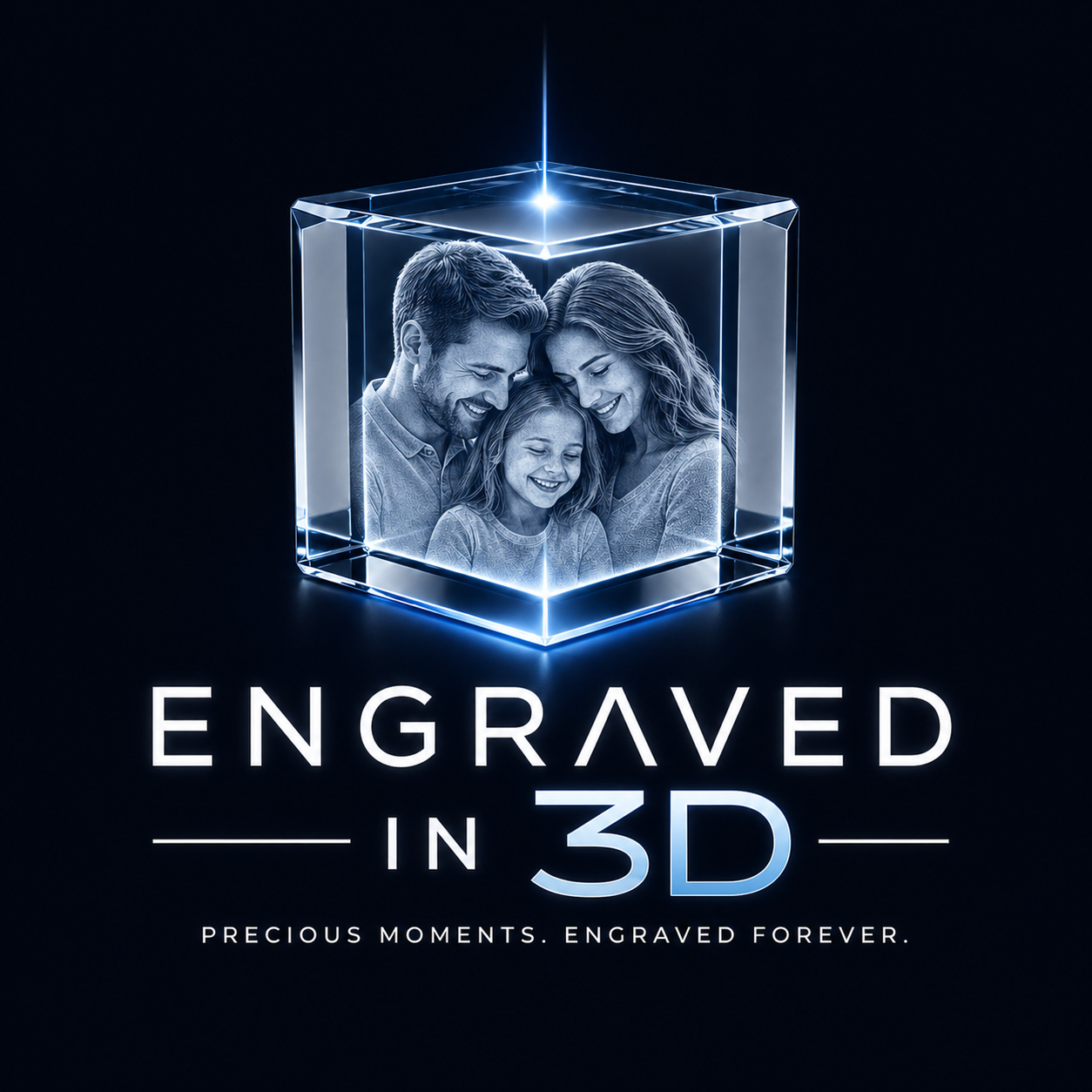
<p>A laser fires thousands of microscopic pulses <em>inside</em> a solid optical crystal — without scratching the surface — creating tiny fracture points that form a three-dimensional image when light passes through them. The result is a glowing portrait floating in glass.</p>
<p>It sounds like science fiction. It's not. Here's exactly how it works.</p>
<h2>Step 1: Converting Your Photo Into a 3D Point Cloud</h2>
<p>The process starts with your photo. Specialized software analyzes the image and converts it into a three-dimensional depth map — essentially a grid of thousands of points, each assigned an X, Y, and Z coordinate.</p>
<p>For portrait photos, the software uses facial recognition and depth estimation to create realistic 3D depth. For flat graphics or text, the engraving is typically set at a single depth plane but still produces a striking effect.</p>
<p>This conversion step is why photo quality matters so much. A high-resolution, well-lit photo gives the software more data to work with, producing a sharper, more detailed final engraving.</p>
<h2>Step 2: Subsurface Laser Engraving (SSLE)</h2>
<p>Once the point cloud is ready, it gets sent to the laser engraving machine as a series of coordinates. This is where the real magic happens.</p>
<p>The laser used in 3D crystal engraving is a <strong>Nd:YAG (neodymium-doped yttrium aluminum garnet) laser</strong> — the same type used in medical procedures and industrial cutting. What makes it special for crystal engraving is its ability to focus at a precise internal point inside the glass without damaging the surface it passes through.</p>
<p>At each coordinate in the point cloud, the laser fires a short, intense pulse. The energy is absorbed at that exact focal point, creating a micro-fracture — a tiny void roughly the size of a grain of sand. The surrounding crystal remains perfectly clear.</p>
<p>Repeat this thousands of times across a precisely mapped set of coordinates, and you get a three-dimensional image built entirely from these tiny internal fractures.</p>
<h2>Step 3: Why the Image Glows</h2>
<p>On its own, a crystal with internal engravings looks faintly visible in normal light. Place it on a color-changing LED base, and the effect becomes dramatic.</p>
<p>Light from the LED enters the crystal from the base and travels upward. When it hits one of the micro-fractures, it scatters — bouncing light in all directions. Because each fracture is positioned at a specific depth and angle, the scattered light creates the illusion of a fully three-dimensional image floating inside the glass.</p>
<p>The LED base typically cycles through multiple colors (red, green, blue, white, and combinations), giving the crystal a dynamic, living quality that makes it genuinely mesmerizing to look at.</p>
<h2>The Crystal Itself: Optical Glass vs. K9 Crystal</h2>
<p>Not all crystals are equal. Lower-end products use standard glass, which has impurities that reduce clarity and create distortion. Premium engravers — including us at Engraved in 3D — use <strong>K9 optical crystal</strong>, a high-grade borosilicate glass with exceptional clarity, low internal stress, and strong light-transmission properties.</p>
<p>K9 crystal is the industry standard for award trophies, high-end optics, and premium personalized gifts. It's heavier and clearer than regular glass, and it produces engravings with significantly more detail and depth.</p>
<h2>What Makes a Good Photo for 3D Engraving?</h2>
<p>Since the entire image is built from depth and contrast data, certain photos engrave better than others:</p>
<ul>
<li><strong>High resolution (1MB+ preferred):</strong> More pixels mean more detail for the conversion software.</li>
<li><strong>Good contrast:</strong> The laser relies on tonal differences to map depth. High-contrast photos engrave more vividly.</li>
<li><strong>Clear subject:</strong> Portraits with a single subject or a small group against a simple background produce the cleanest results.</li>
<li><strong>Natural light:</strong> Outdoor or window-lit photos tend to have even, flattering light that translates well.</li>
</ul>
<p>Avoid heavily filtered photos, very dark or underexposed images, or photos with lots of visual clutter in the background.</p>
<h2>How Long Does It Take?</h2>
<p>A single crystal takes approximately 15–45 minutes to engrave depending on size and complexity. After engraving, each piece is inspected, cleaned, and packed with its LED base before shipping.</p>
<p>At <strong>Engraved in 3D</strong>, we complete and ship most orders within <strong>3–5 business days</strong> from our studio in Sparks, Nevada.</p>
<h2>Ready to Create Yours?</h2>
<p>Now that you know how it works, <a href="/shop">browse our crystal options</a> and upload your photo. Our team reviews every image before engraving to make sure the result will be stunning.</p>
Ready to give a gift they'll keep forever?
Custom 3D laser-engraved crystals — made in Nevada, shipped fast.
Shop Crystal Gifts